 |
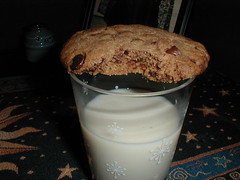
| Some Kind of Milk is in There |
When one has a minority viewpoint, or is otherwise a rare fish in the mainstream, one will often hear certain musings again and again. Sometimes these thoughts have been simmering for years in the mind of
the average-joe-fish, and now she or he finally has a chance to ask. Other times it is a maudlin attempt at original wit, often heard many times by the recipient.
For vegans, one of these topics concerns nomenclature. Often arising as said vegan invites an omnivore to a veg-friendly restaurant.
"Why does it say 'chicken' if it is made from soybeans?"
"Why do they call it a burger if it doesn't taste like a burger?"
"Where are the udders on a soy bean?"
And so forth. As I possess tendencies towards
lingustic descriptivism, I have shrugged off these neologisms and borrowed words as natural
expansion and adaptation of definitions. Typically, I reply to questions like the above by stating the similarities in use and preparation of the vegan and meat versions. For burgers, you take a patty of something and put it on a bun with ketchup, onions, and what-have-you. If you're at the grill and I hand you a veggie burger and call it a veggie burger, you will have some idea what to do with it. If I call it a grain and vegetable patty, you will have no clue. And as far as taste, I'm sure the fast food burgers taste like garbage compared to fancier kinds, yet no one thinks the fast food kind shouldn't be allowed to be called a burger.
 |
| Flag of Hamburg |
Plus a
'burger' or even the longer 'hamburger' does not specifically relate to meat, but to a town in Germany. So it's truly not a very restrictive term. Using 'milk' for soy goes back as far as the liquid in Japan
(though in it's native china it was called more of a drink/beverage), and
atleast 100 years in the west. In the middle ages in Europe,
almond milk was much easier obtain and store than bovine milk, and they had no qualms about calling it milk nor turning it into a butter (or "
botere") substitute. Though I guess the animal butter was actually the substitute.
 |
| Chicken in the Woods? |
Omnivores should look at those four fingers pointing back at them as they blame veg*ns. I doubt whoever came up with hen-of-the-woods (
Grifola frondosa), chicken-of-the-woods (
Laetiporus spp.), and fried-chicken-of-the-woods (
Lyophyllum decastes)
was vegetarian or anything like that. Especially since none of them taste or look like chicken. The first two I know from personal experience, and the last I
rely on
others. Also why I call
Grifola frondosa, maitake (
舞茸) and
Laetiporus, sulphur shelf (in addition to being too confusing).
 |
| Dryococelus australis |
I know the folks who came up with "walking sausage" for the world's rarest insect,
Dryococelus australis, were not vegan as the dinner plate contributed to their decline. However that's an animal named for an animal...
ish.
 |
| Birgus latro |
Yet if naming plant- or fungus-based things after animals is bad, shouldn't naming animals after plants/fungi be just as bad? I mean, a lemon shark (
Negaprion brevirostris) is no lemon (
Citrus × limon), and the coconut crab (
Birgus latro) doesn't taste like coconut.
 |
| The Chicken Lizard |
Although animals are named for plants that they eat or look like, I cannot find an example of an animal named for a plant it tastes like. Though if you ask me, fish taste a lot like the seaweed they eat (protists and not plants, I know, but that designation may change). Though I think if animals were named for what they tasted like, many animals would be called 'chicken.'
If I were to pick something to complain about in naming of things, I would want some accountability for evolutionary precedence. For example, the tiger shark (
Galeocerdo cuvier) evolved
50 mya, and the eponymous tiger (
Panthera tigris) appeared
only 3.2 mya. Clearly the latecomer should be named after the original. Perhaps 'land tiger shark?'
 |
| A Cutie Cuy |
I think people who name things should take more than five seconds to come up with a name, and people also should not become so uptight about what words they use. Yet perhaps both groups should think a little more. Sure, a name like 'Guinea pig' for
Cavia porcellus makes little sense on any level, but few will know what you mean when you use 'cuy' or 'cavy' until a critical mass is built. Like many things, a little patience and intelligence goes a long way.





 Posts