Showing posts with label vegan alternatives. Show all posts

06 June 2011

You Probably are a Cannibal.

I'm Not Supposed to Eat My Hair
Well, cannibalish.  Like the vegetarian of cannibals, as opposed to the vegan of cannibals you thought you were.  Unless you ate anyone I do not know about, and you and your Donner party are on your own.

Anyway, I was perusing the Vegetarian Journal's Guide to Food Ingredients, trying to update my knowledge of ingredients.  I was clicking around when I saw that a some amino acids such as L-cysteine, tryptophan, leucine, isoleucine, and valine may be derived from duck feathers, hog hair, or human hair.  Most of those amino acids primarily are used in nutritional supplements as far as comestibles, but the first, L-cysteine, is frequently found in bread products.  So next time you have a veggie burger and there is hair in your bun, it may be intentional.

Personally, I do not mind the human hair part, but 80% of it comes from duck feathers, although few manufacturers use vegan alternatives.  I imagine that the same issue is a concern in laboratories with amino acids there.  I sent a few emails out asking laboratory suppliers this.  I'll let you know what comes back.

10 November 2009

Poorly Designed Experiments: Shiv a Pig or the Terrorists Win


I have decided to highlight some of the bad as well as the good, in a new segment called Poorly Designed Experiments. I want to shame some of the bad practices out there, and point out some alternatives that would have avoided any animal suffering.

Our first inelegant experiment comes via NCBI ROFL, showing that I'm not the only one finding this paper to be laughable. Though I don't think the pigs involved were smiling:

Byard RW, Cains GE, Gilbert JD. (March 2007) Use of a pig model to demonstrate vulnerability of major neck vessels to inflicted trauma from common household items. The American Journal of Forensic Medicine and Pathology. 28(1):31-4.

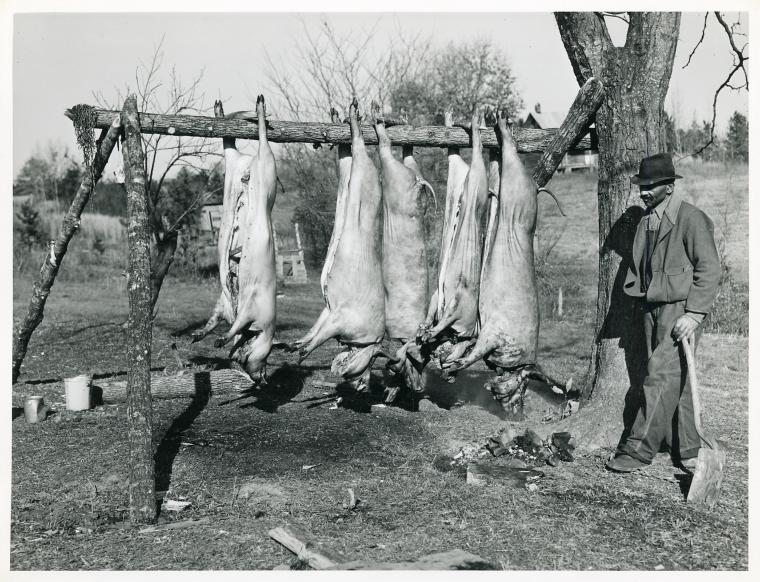
Basically they stabbed "previously euthanized" pigs with pens and other objects to show that no matter what we ban from planes, we will never be 100% safe. Ignoring for the moment the whole charade that these pigs were wallowing happy under rainbows before they passed on painlessly before being used in this study, I have to say I agree with the basic purpose of this study: That security theater is not security.

But the fact that you can stab someone to death with innocuous objects has been proven time and time again, and no place with stricter security than the prison system. One only has to go to the San Quentin Prison Museum to see any number of weapons improvised from the scant items allowed to inmates. Need I mention that that list is a lot more restrictive than what is allowed on commercial planes (and yet they are allowed liquids), and even involves strip-searching. But there are still more than 50 homicides in prisons in the U.S. each year, and a greater number of injuries caused by improvised weapons. Sure, it's a small percentage of the population, but probably a lot larger than the amount of pilots and flight attendants who have been injured similarly. You may argue that those human deaths in out abyssmal prison system outweigh the culling of a few pigs, but then I was able to pull up that website without killing anything. I bet the researchers could have easily obtained photos and castings of wounds from these homicides, and had just as good, if not better, data for their study.

Basically it's the laziness of this study that bugs me. They drove to the hog farm and stabbed some pigs as opposed to contacting hundreds of prison hospitals and collating all the data.

Returning to the pig sourcing issue: I spent some time digging to find swine dead of natural causes. I can't find any information. I hear of this practice a lot in the literature, and on shows like Mythbusters, but it seems be be a black box. Whether this is some informal process where one can just call any old factory farm and they will just happen to have any number of offed pigs for you, or of there are some organized distributors out there I don't know. Either way, it supports the meat industry, either by saving a farm the disposal costs or by purchasing an otherwise unprofitable carcass.

Here are some studies that show similar information without killing pigs:


And here is something to make you laugh after reading about horrible eye trauma. It's more relevant than a unicorn chaser.

30 October 2009

Vegan Witchcraft (and Traditional Medicine)


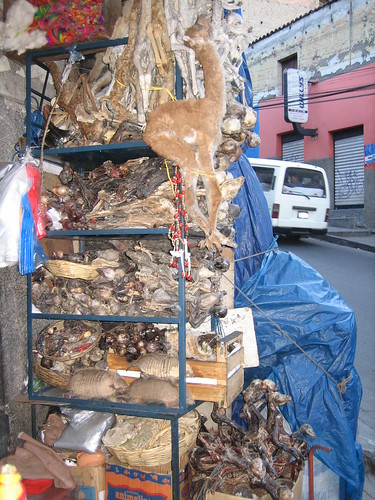
I saw this conveniently-timed article today on a "Witches' Market" in La Paz. So I thought I could make my own seasonally appropriate post.

On the article itself: They mention surreptitiously putting powdered dog's tongue in a person's meal to make them fall in love with you. I'd think for many of us any effect would not last longer than finding out what we just ate, vegan or no.

Also, I liked this quote:
Garcia Fernandez says that most of the fetuses are the results of miscarriages, and the larger ones of still births. Some are obtained if slaughtered llamas happen to be pregnant.

Sure, It's still not vegan, but you could say it's vegetarian, depending on if you think life begins at birth or conception. I mean, some people think eggs are meat and not vegetarian.

What does this all have to do with science? Well, there is a short trip from love potions to traditional medicines for sexual dysfunction. Many traditional medicines have 'gone mainstream' to Western medicine (like aspirin, or even vaccines it could be argued), and in some places like China and India, there is less of a distinction between traditional and modern medicine.

There is a lot of work being done to give rigor and validation to these traditional methods. I tried a search for "traditional Chinese medicine" on PubMed and got so many results I couldn't pick just one.

Sure, many of these medicines are herbs like ginseng and ginko, but in China you can get a prescription for meat if you qi is low. Fortunately in this case, there are alternatives. Likewise, in the case above, the animal impact can be reduced. There is already pressure for alternatives to things like tiger penis and rhinoceros horn because of endangered species legislation and enforcement.

Now while I have spent this post showing how this related to veganism and science, what this whole mess needs is a booster shot of both. We need more science to prove that dog tongue does not induce love and rhinoceros horn does nothing more than accelerate the extinction of pachyderms (they are, look it up). This will reduce the number of animals killed for ingredients and the amount of humans killed by quackery. We need more veganism because there should be more pressure for animal-free versions of these medicinals. Whether it's of Western derivation, like a vaccine made with eggs, or of traditional origin, like herbs substituting for bear bile.

16 September 2009

Vaccines from Plants

I was browsing PubMed and stumbled upon a summary of the Third International Conference on Plant-Based Vaccines and Antibodies which just took place in June. I didn't manage to get access to the full article, but the fact that this has been around since 2005 piqued my interest. Sure, I'd expect that people are experimenting with vaccines in bacterial hosts, the same way any other protein is cranked out in E. coli. This was a little unexpected to me, so I dug deeper.

  1. Santi, L. (September 2009). Plant derived veterinary vaccines. Veterinary Research Communcations. 33 Suppl 1:61-6.

    This article is pretty accessible to non-biologists, and gives a good introduction to this research area. While it's focus is on vaccines for non-human animals, the techniques can clearly be used for human pathogens. I think the concentration on veterinary diseases is mainly due to the amount of testing (read: cost) required to get FDA approval. Edible vaccines also have the benefit of reducing the reliance on antibiotics in non-human animals, and thus slowing the evolution of antibiotic resistance. Conceivably this approach could increase mutation in antigens targets by the vaccines, but I still think that it's a net benefit.

  2. Tacket, C.O. (2009). Plant-Based Oral Vaccines: Results of Human Trials. Current Topics in Microbiology and Immunology. 332:103-17.

    This shows that for both bacterial and viral pathogens, this approach can work in humans. It also has the advantage of not having to involve needles nor chemical (or animal-derived) additives, and is much more stable. Seems to indicate to me that this economical approach will soon be the more common one.

  3. Chebolu, S., and Daniell, H. (2009). Chloroplast-Derived Vaccine Antigens and Biopharmaceuticals: Expression, Folding, Assembly and Functionality. Current Topics in Microbiology and Immunology. 332:33-54.

    I think I'm just a sucker for an exotic host for protein expression. The authors tout the smaller genome and other features that make it a good expression host, But I can see how this could even further reduce problems with allergies and so forth: If you have the vaccine grown up in wheat, and someone has Celiac's disease, you can theoretically transplant the chloroplasts into corn without having to retransfect with a whole new mosaic virus. That and I also like how they say right in the abstract how this can be done "an environmentally friendly manner."
So by no means exhaustive, but it sounds promising to me. It may be a decade before we're chowing down on quinoa for our booster 'shot,' but by that time one plant could literally be a panacea of vaccines.