Showing posts with label animal testing. Show all posts

29 August 2011

A Minor Perk of A Post-Animal-Testing World


Bowser Eats Broccoli
I am a fan of molecular gastronomy, where cooks use scientific understanding and new technology to make better and more novel food.  In a moment of half-baked entrepreneurial spirit, I wondered if the techniques for drug discovery could be applied to developing new flavorings.  So in the same way that the side chain on the penicillin molecule is varied to create benzylpenicillin and phenoxymethylpenicillin, I wondered if one could take vanillin and modify it.  I know there already exists ethylvanillin, but what about butylvanillin, pentylvanillin, or putting something crazier on there?  I think the market for novel capsaicinoids would be immense, especially if one could boost the heat.

Those of you more into the wilds more than the lab, could use a chemical prospecting approach.  There are more than 1,740,330 species of plants, animals, fungi, bacteria, and archaea, and humanity has yet to taste them all.  Especially archaea, which to my knowledge none are eaten by humans intentionally.  Some of the inedible/poisonous ones could still have interesting flavor compounds developed through evolutionary processes.

But I bumped into a hurdle that would be pretty big even without involving my ethics.  Before putting a new chemical in food, it needs safety testing just like a drug would.  I know many labs dread the whole FDA approval process, and that's for life-saving drugs and not frivolities like funny flavors.  Personally, I do not think all those animal lives are worth it.

The science of toxicology is still very young, as evidenced by the century-old animal testing methods still in practice.  But as I have brought to your attention on a few occasions, science is slowly progressing to cheaper, more accurate, and less cruel models of testing.  As with other technological advancements like the Internet and plastics, many other advancements follow as a result.  I think that with the advancement of animal-free tox testing one of the results will be more food options.  Perhaps some new kind of algae, chytrid, or other wee thing we can grow in bulk.

In the long meantime before that day, we'll have to settle for self-testing with 'universal' edibilty tests or by desperation at times of famine. Of course, those of you that forage know that the number of edible plants, protists, and fungi far exceeds what is at the mega-mart.  So you really have no excuse for not trying something new, and living part of the dream today.

18 July 2011

3D Herpes Test Saves Animal Lives

Herpes Simplex
No, not a test to see if you have 3D herpes, or any other kind, but a test to study herpes simplex virus in vivo.  By the way, thanks to your mom for sending this in.  Apparently she's an expert on herpes.

Anyway, Dr. Anke Burger-Kentischer of the Institut für Grenzflächenverfahrenstechnik at Stuttgart, along with her team and the cell systems department recently developed a three-dimensional infection model for the herpes virus.  Because herpes flares up with cold sores on the lip and then hides in a lysogenic phase in the nerve cells, it is difficult to study.  This new model makes it easier to detect if the virus is really gone or just dormant.  Like similar news previously reported here, this approach replaces animal testing with a more useful and less cruel alternative.

Dr. Burger-Kentischer believes that the model can be adapted to study another member of alphaherpesvirinae, the varicella zoster virus, which causes shingles and chicken pox.  Of course, you all received your vaccination for that, right?  I know the vaccine has gelatin in it and is created using chicken embryos, but besides saving human lives, vaccination removes the need for animal testing and research using animal products.  If you want to make a change, go to the crux of the issue and press for vegan vaccines.  In the meantime, circle circle dot dot...

15 May 2011

Coumarin: Another Misadventure of Animal Testing

Coumarin
Not long ago, I was at a colleague's home, and she produced a bottle of spirit with buffalo grass in it.  I had never heard of this organism, and found out that Hierochloe odorata is one of many plants used to impart a sweet grassy aroma to food and drink.

The compound responsible for this flavor is coumarin.  You may have culinary knowledge of it by using woodruff (Galium odoratum) or tonka bean (Dipteryx odorata).  The latter gives the compound its name through the original Tupi word kumarú.  Tonka bean extracts and coumarin additives in food are also explicitly banned in food in the United States as of 1954.  It also faces similar reprobations in Deutschland.

Alert readers and those past their first cup of coffee may notice a loophole:  One can add woodruff or one of the many other plants containing coumarin to food legally.  In fact, woodruff is explicitly legal in alcoholic beverages.

So why all the hubbub?  Why make it illegal to any degree?  Well, rats that injest coumarin break it down into coumarin 3,4-epoxide, which kills the liver.  Coumarin and it's derivatives are used as a rodenticide for this reason.  However, rats and humans are different, and humans metabolize coumarin to 7-hydroxycoumarin, which is markedly less toxic.

Coumarin is also in sweet clover, and if silage is made of it for livestock, some species of fungi will transform the coumarin to dicoumarol and cause the hemorrhagic Sweet Clover Disease.  But again, humans are not cattle and also do not eat fermented clover. 

Coumarin is also the precursor to the anticoagulant warfarin, which like many medicines can be toxic if misused.  However, warfarin is synthesized from dicoumarol, and not coumarin directly, and coumarin does not have the anticoagulating effect that warfarin does.

I did a small amount of searching and could not find any incidents of coumarin poisoning in humans that was from coumarin itself and not due to a coumarin derivative.  I welcome anyone to show me otherwise.

The bit that really shows how coumarin is not as scary as people think, which those who already clicked on some of the above links may have gleaned, is that most of us have already consumed substantial amounts of coumarin, especially in the form of cinnamon.  Cassia cinnamon (Cinnamomum aromaticum), which is what is most common in supermarkets, has 2,100-4,400 PPM of coumarin.  Although woodruff has about thrice as much and the tonka bean has about tenfold as much, cinnamon is still in the ballpark and not quite as much the pariah.  Other commonly-consumed sources are coumarin include jujube (Ziziphus zizyphus), lavender (Lavandula angustifolia), peppermint (Mentha x piperita), celery (Apium graveolens), carrot (Daucus carota), and many more legal plants without scary warnings. 

So the general public is clearly capable of consuming coumarin safely.  We should not continue to ban coumarin based on old and misleading animal testing data and guilt by association.  Think this is silly and needs to be changed?  Contact the FDA and tell them how you feel.  You may also want to ask them about safrole and thujone.


Important:  Consume tonka bean, woodruff, and other plants with coumarin at your own risk.  Read up on it further and make your own decision.  I don't want to tell you what you can and cannot eat any more than I think a government should.  Also, make sure you know the law in your area and make your own decisions.

Also, there is clearly a dearth of vegan recipes online for tonka. If you do decide to break the law try some, let me know what you come up with.  Looks fairly easy to get tonka online, so have fun, don't die, and don't get me in trouble.

23 April 2011

Today, in False Dichotomy

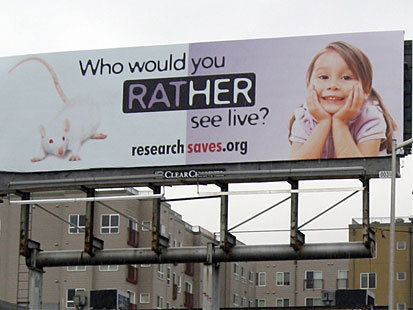
I was driving the automobile yesterday, when I saw a distasteful (in my opinion) billboard.


I mean look at that!  A vermin escaped from a mad scientist's lab versus the cute white girl that cable news networks go nuts for when one is missing or down a well.  The social construction on this thing is crazy.  They even split up the word "RATHER" into "RAT" and "HER."


I have a few disparate responses.  First, it should be obvious to anyone who does not immediately believe every ad they see that real life isn't that black and white.  Much animal testing is avoidable, unnecessary, or pointless.  Much of it has nothing to do with life or death situations.  Much of it is like testing pomegranate juice to the point of brain damage to test any health benefits to humans.  I'd like to see that billboard.  Much of it has to be redone on humans anyway, or else if we tested chocolate on dogs or strychnine on hamsters we'd be in for surprises.

Plus, and I hate to invoke Godwin's Law so soon, just because research saves lives doesn't make it right.  If you click on those links you will be thinking of an even more absurd and grim iteration of the billboard above.  I could also go one step more and combine pointless experiments with those conducted on low-status humans and mention the Tuskegee syphilis experiments (and the associated ones in Guatemala).

Besides weeding out all those pointless or avoidable tests, many animal testing can be further minimized by testing on cell cultures, tissues, and the like first.  This won't catch every pitfall, but it will catch some.  It's also cheaper, and that's why more and more companies are using these tests and developing more.

Essentially, I'd like to see more resources put to developing tests to avoid animal testing.  Besides saving animals both human and non, it will mean I won't have to see this billboard.

So who would I rather see live?  Both the cute fuzzy and the brat, and while I'm making demands let's make her vegan.  :þ

04 February 2010

The 'Natural' Human Diet

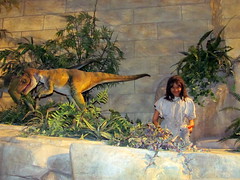
Creation Museum - Kentucky
Oftentimes, I have an idea for a post and I procrastinate. Then something else comes to my attention that dovetails with the original idea.

Such is the case now when I watched the Daily Colbert tonight, where the guest was John Durant. He spoke about his new "caveman" diet/way-of-life that he thinks is our one true diet. We should be eating more meat, and no bread. People in paleolithic societies live to ripe old ages as long as they don't die in early childhood. All our diseases are due to our eating "modern" (read: 'processed') foods. And other such nuggets of folk wisdom.

Now you may think that the whole fAtkins diet rebranding gets my knickers in a twist because it's contrary to the vegan thing you heard I like. But that's only a small reason, if any. Mainly it's this whole nostalgia for the past that never was. The cartoon version of primitive humans taking a bite out of a mammoth simply isn't true. I think Wikipedia has a good summary. The concept is just a continuation of the whole natural-is-automatically-good-for-you mantra that just bugs the heck out of me (arsenic, uranium, strychnine, poliovirus, all natural! they must be good for you!)

Durant's main point seems to be that we should eat the diet we have evolved to eat. He just thinks that in the 10,000 years since the dawn of agriculture humans have not evolved.

This brings me to the original item I was going to post, that shows that we have evolved since then. It points to an event that changed our bodies more than agriculture has, that being that Promethean moment we started cooking. Primatologist Richard Wrangham has many interesting points in the podcast, and I plan on digging in to his book (pun intended) for more.

The point that stuck out for me, especially as someone who has done more polyacrylamide gel electrophoresis (PAGE) than is probably good for them. As anyone who has poured their own gels, or had to dispose of used gels knows (or perhaps, only those of the above who read the MSDS), the acrylamide monomer of the gel is described as a potent neurotoxin (atleast when tested on cats).

Yet our friend C3H5NO is found in starchy cooked foods that most of us eat every day. Those very same unnatural breads and pastas and baked potatoes that raw-foodists and paleo-dieters flee from. How can this be? Richard Wrangham and others (including your humble narrator) think this is one of many evolutionary adaptations that modern H. sapiens has gained since cooking and processing food.

And I find it especially funny (if morbidly) that much of the negative health indications derive from animal tests, as in the aforementioned one with the poor kitties. If we tested chocolate on dogs, we'd never be able to eat that either (and that's a processed food too). But if we tested all-natural raw strychnine in guinea pigs we'd be in for a shock when that product hit the shelves.

Im not saying we should all load up on deep-fried vegan twinkies, I just think we should eat healthy, and not eat something because it's natural. And of course, eat without killing animals. But you knew that.

23 January 2010

French Stop Testing Oysters on Mice

Oyster photo by Alain Feulvarch
Yes, you read that right. I heard this first on the radio, but there are better text versions here in English and here en français.

The gist is that since oysters are filter-feeders in the big wide ocean, and not raised in a closed system of a farm, and they can pick up pathogens pretty easy. So there are naturally food-safety concerns (ignoring the heavy metals and toxins). So many governments started testing digestive fluid from the oysters by injecting it into mice and seeing if they died (the mouse bioassay, or test de la souris). Very base test. Fast forward a few decades, and most governments find faster, cheaper, more reliable, less cruel ways to test the pathogenicity of oysters. Yet up until recently, France was shelling out money (yuk-yuk) for the old muricidal method. Finally, they have switched to the better-in-almost-every-way chemical test.

Why did this happen? Seems many French oyster farmers were upset that mice oftentimes die even if the oysters were 'clean.' This would mean whole regions of coast would be banned from selling oysters, and many people went bankrupt and so forth. So the oysterfolk complained, and eventually got the change they wanted. I can find no indication that any animal-rights groups were involved (they dropped the ball)

Now I am glad that more mice are living, but upset that perhaps more oysters will die. I am more glad that another unreliable animal test has been ditched in favor of a more reliable cruelty-free test. Though I can not find out precisely which test they are using now, it is a good point to bring up when people tell you that animal testing is 'needed.'

10 November 2009

Poorly Designed Experiments: Shiv a Pig or the Terrorists Win


I have decided to highlight some of the bad as well as the good, in a new segment called Poorly Designed Experiments. I want to shame some of the bad practices out there, and point out some alternatives that would have avoided any animal suffering.

Our first inelegant experiment comes via NCBI ROFL, showing that I'm not the only one finding this paper to be laughable. Though I don't think the pigs involved were smiling:

Byard RW, Cains GE, Gilbert JD. (March 2007) Use of a pig model to demonstrate vulnerability of major neck vessels to inflicted trauma from common household items. The American Journal of Forensic Medicine and Pathology. 28(1):31-4.

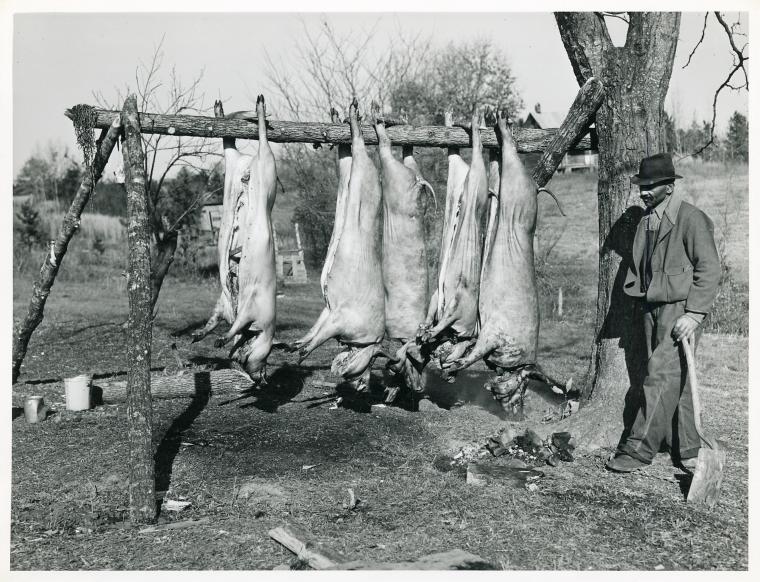
Basically they stabbed "previously euthanized" pigs with pens and other objects to show that no matter what we ban from planes, we will never be 100% safe. Ignoring for the moment the whole charade that these pigs were wallowing happy under rainbows before they passed on painlessly before being used in this study, I have to say I agree with the basic purpose of this study: That security theater is not security.

But the fact that you can stab someone to death with innocuous objects has been proven time and time again, and no place with stricter security than the prison system. One only has to go to the San Quentin Prison Museum to see any number of weapons improvised from the scant items allowed to inmates. Need I mention that that list is a lot more restrictive than what is allowed on commercial planes (and yet they are allowed liquids), and even involves strip-searching. But there are still more than 50 homicides in prisons in the U.S. each year, and a greater number of injuries caused by improvised weapons. Sure, it's a small percentage of the population, but probably a lot larger than the amount of pilots and flight attendants who have been injured similarly. You may argue that those human deaths in out abyssmal prison system outweigh the culling of a few pigs, but then I was able to pull up that website without killing anything. I bet the researchers could have easily obtained photos and castings of wounds from these homicides, and had just as good, if not better, data for their study.

Basically it's the laziness of this study that bugs me. They drove to the hog farm and stabbed some pigs as opposed to contacting hundreds of prison hospitals and collating all the data.

Returning to the pig sourcing issue: I spent some time digging to find swine dead of natural causes. I can't find any information. I hear of this practice a lot in the literature, and on shows like Mythbusters, but it seems be be a black box. Whether this is some informal process where one can just call any old factory farm and they will just happen to have any number of offed pigs for you, or of there are some organized distributors out there I don't know. Either way, it supports the meat industry, either by saving a farm the disposal costs or by purchasing an otherwise unprofitable carcass.

Here are some studies that show similar information without killing pigs:


And here is something to make you laugh after reading about horrible eye trauma. It's more relevant than a unicorn chaser.

17 June 2009

Human Lungs are Better for Testing than Rat Lungs

A good step in getting rid of animal testing recently, according to The New Scientist. Kelly BéruBé at the University of Cardiff has developed a way to scaffold human lung cells in 3d. This will allow for more accurate data over 2d cultures because it accounts for air flow and so forth, but also it will be more accurate over non-human animal models because it is using human cell lines. Remember, if we tested chocolate on dogs it'd be banned and if we tested strychnine on hamsters it would be counted as nontoxic.

Eventually the technique could be applied to chips, and theoretically be used as a substritute for the canary in the coal mine. Perhaps literally.

http://www.newscientist.com/article/mg20227126.800-lungonachip-could-replace-countless-lab-rats.html