Showing posts with label chicken. Show all posts

30 October 2011

Don't Call it Milk if it's Soy?

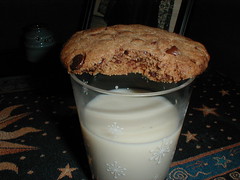
Vegan Chocolate Chip Cookie and Soymilk
Some Kind of Milk is in There
When one has a minority viewpoint, or is otherwise a rare fish in the mainstream, one will often hear certain musings again and again.  Sometimes these thoughts have been simmering for years in the mind of the average-joe-fish, and now she or he finally has a chance to ask.  Other times it is a maudlin attempt at original wit, often heard many times by the recipient.

For vegans, one of these topics concerns nomenclature.   Often arising as said vegan invites an omnivore to a veg-friendly restaurant.

"Why does it say 'chicken' if it is made from soybeans?"

"Why do they call it a burger if it doesn't taste like a burger?"

"Where are the udders on a soy bean?"

And so forth.  As I possess tendencies towards lingustic descriptivism, I have shrugged off these neologisms and borrowed words as natural expansion and adaptation of definitions.  Typically, I reply to questions like the above by stating the similarities in use and preparation of the vegan and meat versions.  For burgers, you take a patty of something and put it on a bun with ketchup, onions, and what-have-you.  If you're at the grill and I hand you a veggie burger and call it a veggie burger, you will have some idea what to do with it.  If I call it a grain and vegetable patty, you will have no clue.  And as far as taste, I'm sure the fast food burgers taste like garbage compared to fancier kinds, yet no one thinks the fast food kind shouldn't be allowed to be called a burger.

Flag of Hamburg
Plus a 'burger' or even the longer 'hamburger' does not specifically relate to meat, but to a town in Germany.  So it's truly not a very restrictive term.  Using 'milk' for soy goes back as far as the liquid in Japan (though in it's native china it was called more of a drink/beverage), and atleast 100 years in the west.  In the middle ages in Europe, almond milk was much easier obtain and store than bovine milk, and they had no qualms about calling it milk nor turning it into a butter (or "botere") substitute.  Though I guess the animal butter was actually the substitute.

Chicken in the woods
Chicken in the Woods?
Omnivores should look at those four fingers pointing back at them as they blame veg*ns.  I doubt whoever came up with hen-of-the-woods (Grifola frondosa), chicken-of-the-woods (Laetiporus spp.), and fried-chicken-of-the-woods (Lyophyllum decastes) was vegetarian or anything like that.  Especially since none of them taste or look like chicken.  The first two I know from personal experience, and the last I rely on others.  Also why I call Grifola frondosa, maitake (舞茸) and Laetiporus, sulphur shelf (in addition to being too confusing).

Lord Howe Island stick insect Dryococelus australis 10June2011 PalmNursery
Dryococelus australis
I know the folks who came up with "walking sausage" for the world's rarest insect, Dryococelus australis, were not vegan as the dinner plate contributed to their decline.  However that's an animal named for an animal...ish.

Birgus latro (Bora-Bora)
Birgus latro
Yet if naming plant- or fungus-based things after animals is bad, shouldn't naming animals after plants/fungi be just as bad?  I mean, a lemon shark (Negaprion brevirostris) is no lemon (Citrus × limon), and the coconut crab (Birgus latro) doesn't taste like coconut.

Alligator 1
The Chicken Lizard
Although animals are named for plants that they eat or look like, I cannot find an example of an animal named for a plant it tastes like.  Though if you ask me, fish taste a lot like the seaweed they eat (protists and not plants, I know, but that designation may change).  Though I think if animals were named for what they tasted like, many animals would be called 'chicken.'

If I were to pick something to complain about in naming of things, I would want some accountability for evolutionary precedence.  For example, the tiger shark (Galeocerdo cuvier) evolved 50 mya, and the eponymous tiger (Panthera tigris) appeared only 3.2 mya.  Clearly the latecomer should be named after the original.  Perhaps 'land tiger shark?'

Guinea pig-Meerschweinchen
A Cutie Cuy
I think people who name things should take more than five seconds to come up with a name, and people also should not become so uptight about what words they use.  Yet perhaps both groups should think a little more.  Sure, a name like 'Guinea pig' for Cavia porcellus makes little sense on any level, but few will know what you mean when you use 'cuy' or 'cavy' until a critical mass is built.  Like many things, a little patience and intelligence goes a long way.

18 July 2011

3D Herpes Test Saves Animal Lives

Herpes Simplex
No, not a test to see if you have 3D herpes, or any other kind, but a test to study herpes simplex virus in vivo.  By the way, thanks to your mom for sending this in.  Apparently she's an expert on herpes.

Anyway, Dr. Anke Burger-Kentischer of the Institut für Grenzflächenverfahrenstechnik at Stuttgart, along with her team and the cell systems department recently developed a three-dimensional infection model for the herpes virus.  Because herpes flares up with cold sores on the lip and then hides in a lysogenic phase in the nerve cells, it is difficult to study.  This new model makes it easier to detect if the virus is really gone or just dormant.  Like similar news previously reported here, this approach replaces animal testing with a more useful and less cruel alternative.

Dr. Burger-Kentischer believes that the model can be adapted to study another member of alphaherpesvirinae, the varicella zoster virus, which causes shingles and chicken pox.  Of course, you all received your vaccination for that, right?  I know the vaccine has gelatin in it and is created using chicken embryos, but besides saving human lives, vaccination removes the need for animal testing and research using animal products.  If you want to make a change, go to the crux of the issue and press for vegan vaccines.  In the meantime, circle circle dot dot...

27 October 2009

Future of Vaccine Production

Heard this NPR story while getting my vehicle emissions test today. They don't have a transcript yet, but it basically shows how slow and inefficient current vaccine production with embryonated chicken eggs is. One tidbit I got is that one opts for the nasal vaccine and not the shot, you use only 1/100th of an egg as oppose to a full chicken abortion.

The hope is that they are starting to use animal cell lines, which while they may have originally come from an animal have long since stopped harming that particular animal. They mentioned a canine kidney cell line, as opposed to Vero cells (mentioned often on this site) as being a much better system for viral production.

Then they went a step further, and bring up a new caterpillar-derived system for making viral proteins for a vaccine. This was new to me. I was worried at first, because cell-free protein synthesis using wheat germ or rabbit reticulocytes ends up killing the heat or rabbit.

After some digging, I found that the system uses a cell line (and not fresh animals for each batch) from a moth, the fall armyworm (Spodoptera frugiperda) with help from Baculovirus. Exciting stuff.

Further reading:
1) Maiorella, B., Inlow, D., Shauger, A., & Harano, D. (1988). Large-Scale Insect Cell-Culture for Recombinant Protein Production. Nature Biotechnology. 6:1406-1410.

2) Ikonomoi, L., Schneider, Y.-J., Agathos, S. N. (July 2003). Insect cell culture for industrial production of recombinant proteins. Applied Microbiology and Biotechnology. 62(1):1-20.


Post Scriptum:
This post has been mentioned here. Thanks Mr. Dandelion!

23 September 2009

Eggless Swine Flu Vaccines coming to Europe

This is an update on a story being followed here. I was perusing the Baxter website for news, and found this out-of-date update. Deciding to do some minor journalism, I emailed them, and just got a reply from Karoline Traschler, Project Marketing Manager for Global Marketing Vaccines:

We thank you for your interest in our H1N1 vaccine. We expect European licensure by end of September. We have to inform you that it will not be available on the US market.


The last sentence is of concern, being stateside and all. I replied asking for clarification, but I'd imagine it'd have to do with the stricter drug safety regulations here (thanks a lot, thalidamide!). I'll keep you posted.

28 April 2009

Vaccines without Chickens

You may not know that 'vaccine' originally meant something like 'bovine.' They don't involve cows anymore, but they do usually use chickens. Or atleast eggs in development with a nascent and pliable immune system that can be manipulated to make antibodies. Like many crude methods, this takes time, is imprecise, and causes problems for people with allergies and ethical concerns.

So to work in another animal into this post, I heard a report this morning regarding swine flu. It mentioned a company that has found a way to make vaccines faster, and more importantly, egg free. According to Baxter's site, they use Vero cell cultures instead of the eggs. While originally derived from the kidney of a grivet, I feel it is so far removed from that long-dead monkey to consider that aspect to be ethically OK. Sure, people with monkey allergies and concern over hereto unknown prion diseases can object, but atleast it's not aborting factory-farmed chickens. One step at a time folks!

One concern with this methodology (and also with in vitro meat) is that Vero cells are typically grown with the use of fetal bovine serum (FBS). Thus exchanging chicken fetuses for cattle fetuses. Net gain of zero, unless you think the unhatched chicken eggs are vegetarian, but that's a slippery slope. I looked into it a little more, and according to a document on the Baxter site:

"Also, Baxter’s Vero cell system is capable of producing very high yields of influenza virus without the addition of any animal-derived serum."
That's possibly great news. I sent them an email to confirm. I'll post if there is a reply.

Swine Flu May Test Baxter
Baxter Vaccines
Vero Cell Backgrounder