A few new techniques have popped up that are illuminating the food web a little more clearly.
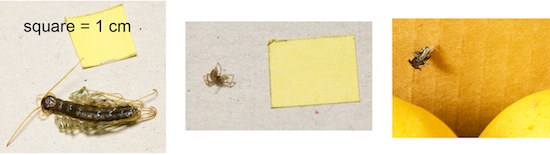
The first caught my ear through the Science Friday weekly video. Two NYC high schoolers, Brenda Tan and Matt Cost, took samples of a number of food items (as well as some amusing non-food specimens) sequenced thw COI gene in the mitochondrial DNA, and checked the 'barcodes.' This method is fairly robust, because using mitochondria you can type from hair and other non-cellular samples, and "even sequences as short as 20 nucleotides could be used to match to just one of the tens of thousands of species in the database."
The project is billed as this general interest science piece, but it has implications for the target demographic of this blog in a few ways, mainly relating to proper labeling. In this project and in a previous project done by the same mentor, many mislabeled products. A few were engangered species, including Sebastes fasciatus, or the Acadian redfish. Though the main trend was to 'downpour' and sell cheaper, more common species in place of rarer and more expensive ones. Even so there is an impact on the environment. Depending on who is doing the mislabeling, as it could be the original fisherman or harvester, this would be skewing much of the data being collected on sustainable wild harvesting of many foods. As this technology becomes more readily available it will be easier to have more accurate and less obfuscated information at the disposal of conversation groups and so forth.
Another point of interest I saw in this project was that this approach can easily be used by vegans in more focused truth-in-labeling tests, similar to those mentioned previously here. And in fact, would be cheaper and more accurate than the specific tests performed in that instance. I think I shall email those folks and see if they are game for it. They clearly have better funding than I.
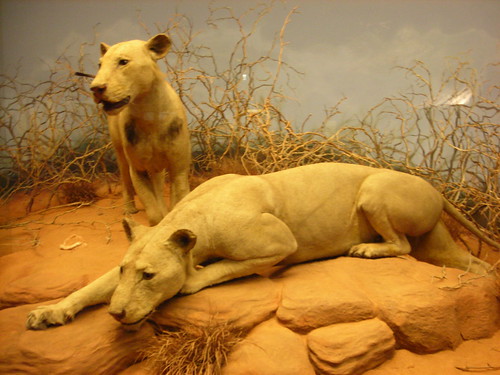
The second item in my foodweb amalgam post is concerning a technique used to tell diet of an animal (or person) from samples of bone collagen and hair keratin, using ratios of radioactive carbon and nitrogen isotopes present. The study comes via the recently-moved NCBI-ROFL, and is a test on the extent of the infamous Maneaters of Tsavo horrible diet. The study seems like a proof-of-concept of the technique on a flashy general-interest subject to drum up support (nothing wrong with that). I can also see this technique being used to clear up some things of interest to us folk. Were primitive humans mainly meat-eaters? Was Hitler a vegetarian? And for the vegetarians, it could perhaps verify if the milk and eggs are from animals that were not fed other animals.
Showing posts with label experiment. Show all posts
24 January 2010
If we Find out What we Eat, Do we Find out What we are?
Labels:
Acadian Redfish,
diet,
experiment,
fiood web,
food,
food chain,
ingredients,
labelling,
labels,
lions,
Maneaters of Tsavo,
Sebastes fasciatus
10 November 2009
Poorly Designed Experiments: Shiv a Pig or the Terrorists Win
I have decided to highlight some of the bad as well as the good, in a new segment called Poorly Designed Experiments. I want to shame some of the bad practices out there, and point out some alternatives that would have avoided any animal suffering.
Our first inelegant experiment comes via NCBI ROFL, showing that I'm not the only one finding this paper to be laughable. Though I don't think the pigs involved were smiling:
Byard RW, Cains GE, Gilbert JD. (March 2007) Use of a pig model to demonstrate vulnerability of major neck vessels to inflicted trauma from common household items. The American Journal of Forensic Medicine and Pathology. 28(1):31-4.
Basically they stabbed "previously euthanized" pigs with pens and other objects to show that no matter what we ban from planes, we will never be 100% safe. Ignoring for the moment the whole charade that these pigs were wallowing happy under rainbows before they passed on painlessly before being used in this study, I have to say I agree with the basic purpose of this study: That security theater is not security.
But the fact that you can stab someone to death with innocuous objects has been proven time and time again, and no place with stricter security than the prison system. One only has to go to the San Quentin Prison Museum to see any number of weapons improvised from the scant items allowed to inmates. Need I mention that that list is a lot more restrictive than what is allowed on commercial planes (and yet they are allowed liquids), and even involves strip-searching. But there are still more than 50 homicides in prisons in the U.S. each year, and a greater number of injuries caused by improvised weapons. Sure, it's a small percentage of the population, but probably a lot larger than the amount of pilots and flight attendants who have been injured similarly. You may argue that those human deaths in out abyssmal prison system outweigh the culling of a few pigs, but then I was able to pull up that website without killing anything. I bet the researchers could have easily obtained photos and castings of wounds from these homicides, and had just as good, if not better, data for their study.
Basically it's the laziness of this study that bugs me. They drove to the hog farm and stabbed some pigs as opposed to contacting hundreds of prison hospitals and collating all the data.
Returning to the pig sourcing issue: I spent some time digging to find swine dead of natural causes. I can't find any information. I hear of this practice a lot in the literature, and on shows like Mythbusters, but it seems be be a black box. Whether this is some informal process where one can just call any old factory farm and they will just happen to have any number of offed pigs for you, or of there are some organized distributors out there I don't know. Either way, it supports the meat industry, either by saving a farm the disposal costs or by purchasing an otherwise unprofitable carcass.
Here are some studies that show similar information without killing pigs:
- Turbin R, Maxwell D, Langer P, Frohman L, Hubbi B, Wolansky L, Mori M. (September 2006) Patterns of Transorbital Intracranial Injury: A Review and Comparison of Occult and Non-Occult Cases. Survey of Ophthalmology. Volume 51, Issue 5, Pages 449-460
- Patton N. (5 March 2004) Self-inflicted eye injuries: a review. Eye. 18, 867–872.
- Lunetta P, Ohberg A, Sajantila A. (December 2002) Suicide by intracerebellar ballpoint pen. The American Journal of Forensic Medicine and Pathology. 23(4):334-7.
- Ramaswamy R, Dow G, Bassi S. (2006) Pencil Is Mightier than the Sword! Pediatric Neurosurgery. 42:168-170
- Yamaguchi S, Eguchi K, Takeda M, Hidaka T, Shreshta P, Kurisu K. (2007) Penetrating Injury of the Upper Cervical Spine by a Chopstick. Neurologia medico-chirurgica. Vol. 47, pp.328-330
- Tenenholz T, Baxter A B, McKhann G M. (July 1999) Orbital assault with a pencil: Evaluating vascular injury. American Journal of Roentgenology. 173(1):144.
And here is something to make you laugh after reading about horrible eye trauma. It's more relevant than a unicorn chaser.
30 June 2009
Scientific Vegan
Just read a post that was the converse of my site. Being more of a vegan heading towards science than the other way around. A Mr. Meaner at QuarryGirl.com undertakes some rigorous testing on food served at all-vegan restaurants in the Los Angeles area. They determined that a number of places had food contaminated with animal products, and in one case suspect foul play. Mostly though, as the trail is taken all the way to the Taiwanese goverment, they blame poor labelling at the manufacturer. And kudos to them for being so persistent. It is noted that new legislation in Taiwan on such matters goes into effect tomorrow and should help straighten things out. Expect a some changes at your local restaurants, especially the Asian veg ones.
I do see a few issues with the experiment. First, I'd like to know which tests specifically they used. As Schmod on BoingBoing points out:
For starters, are there any legitimately vegan ingredients that could register a false-positive on these tests? What is the effectiveness of the testing kits that they used? Why were they afraid to disclose the manufacturer of said kits?Ideally the manufacturer's protocol and so forth could be published to eliminate these questions.
Also, I think they should have a better negative control than just the lab bench. That information is good, but ideally you want something in the ballpark of the other things being tested, perhaps a home-cooked vegan dish with known ingredients. Similarly, I think they should have found menu items that were the as close to similar as possible at each restaurant. I note that quesadillas were common, but I think they should have done only quesadillas (or close analogs like a taco or something). At the very least, only doing veg-chicken dishes or something with a single unifying common ingredient (or supposed common ingredient). I can't really compare a quesadilla to tiramisu.
All in all though, they did a good job, and i'd like to see more of this thing. Perhaps Mr. Meaner can repeat the experiment in a year or so after the labelling laws in Taiwan go into effect? One can hope.
http://www.quarrygirl.com/2009/06/28/undercover-investigation-of-la-area-vegan-restaurants/
Labels:
eggs,
experiment,
food,
ingredients,
milk,
restaurant,
science,
shellfish,
Taiwan,
vegan
Subscribe to:
Posts (Atom)