Showing posts with label vaccine. Show all posts

18 July 2011

3D Herpes Test Saves Animal Lives

Herpes Simplex
No, not a test to see if you have 3D herpes, or any other kind, but a test to study herpes simplex virus in vivo.  By the way, thanks to your mom for sending this in.  Apparently she's an expert on herpes.

Anyway, Dr. Anke Burger-Kentischer of the Institut für Grenzflächenverfahrenstechnik at Stuttgart, along with her team and the cell systems department recently developed a three-dimensional infection model for the herpes virus.  Because herpes flares up with cold sores on the lip and then hides in a lysogenic phase in the nerve cells, it is difficult to study.  This new model makes it easier to detect if the virus is really gone or just dormant.  Like similar news previously reported here, this approach replaces animal testing with a more useful and less cruel alternative.

Dr. Burger-Kentischer believes that the model can be adapted to study another member of alphaherpesvirinae, the varicella zoster virus, which causes shingles and chicken pox.  Of course, you all received your vaccination for that, right?  I know the vaccine has gelatin in it and is created using chicken embryos, but besides saving human lives, vaccination removes the need for animal testing and research using animal products.  If you want to make a change, go to the crux of the issue and press for vegan vaccines.  In the meantime, circle circle dot dot...

30 October 2009

Vegan Witchcraft (and Traditional Medicine)


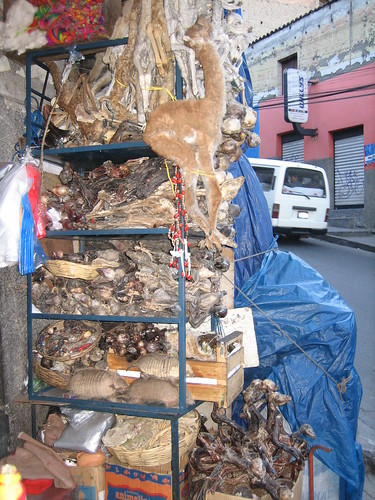
I saw this conveniently-timed article today on a "Witches' Market" in La Paz. So I thought I could make my own seasonally appropriate post.

On the article itself: They mention surreptitiously putting powdered dog's tongue in a person's meal to make them fall in love with you. I'd think for many of us any effect would not last longer than finding out what we just ate, vegan or no.

Also, I liked this quote:
Garcia Fernandez says that most of the fetuses are the results of miscarriages, and the larger ones of still births. Some are obtained if slaughtered llamas happen to be pregnant.

Sure, It's still not vegan, but you could say it's vegetarian, depending on if you think life begins at birth or conception. I mean, some people think eggs are meat and not vegetarian.

What does this all have to do with science? Well, there is a short trip from love potions to traditional medicines for sexual dysfunction. Many traditional medicines have 'gone mainstream' to Western medicine (like aspirin, or even vaccines it could be argued), and in some places like China and India, there is less of a distinction between traditional and modern medicine.

There is a lot of work being done to give rigor and validation to these traditional methods. I tried a search for "traditional Chinese medicine" on PubMed and got so many results I couldn't pick just one.

Sure, many of these medicines are herbs like ginseng and ginko, but in China you can get a prescription for meat if you qi is low. Fortunately in this case, there are alternatives. Likewise, in the case above, the animal impact can be reduced. There is already pressure for alternatives to things like tiger penis and rhinoceros horn because of endangered species legislation and enforcement.

Now while I have spent this post showing how this related to veganism and science, what this whole mess needs is a booster shot of both. We need more science to prove that dog tongue does not induce love and rhinoceros horn does nothing more than accelerate the extinction of pachyderms (they are, look it up). This will reduce the number of animals killed for ingredients and the amount of humans killed by quackery. We need more veganism because there should be more pressure for animal-free versions of these medicinals. Whether it's of Western derivation, like a vaccine made with eggs, or of traditional origin, like herbs substituting for bear bile.

27 October 2009

Future of Vaccine Production

Heard this NPR story while getting my vehicle emissions test today. They don't have a transcript yet, but it basically shows how slow and inefficient current vaccine production with embryonated chicken eggs is. One tidbit I got is that one opts for the nasal vaccine and not the shot, you use only 1/100th of an egg as oppose to a full chicken abortion.

The hope is that they are starting to use animal cell lines, which while they may have originally come from an animal have long since stopped harming that particular animal. They mentioned a canine kidney cell line, as opposed to Vero cells (mentioned often on this site) as being a much better system for viral production.

Then they went a step further, and bring up a new caterpillar-derived system for making viral proteins for a vaccine. This was new to me. I was worried at first, because cell-free protein synthesis using wheat germ or rabbit reticulocytes ends up killing the heat or rabbit.

After some digging, I found that the system uses a cell line (and not fresh animals for each batch) from a moth, the fall armyworm (Spodoptera frugiperda) with help from Baculovirus. Exciting stuff.

Further reading:
1) Maiorella, B., Inlow, D., Shauger, A., & Harano, D. (1988). Large-Scale Insect Cell-Culture for Recombinant Protein Production. Nature Biotechnology. 6:1406-1410.

2) Ikonomoi, L., Schneider, Y.-J., Agathos, S. N. (July 2003). Insect cell culture for industrial production of recombinant proteins. Applied Microbiology and Biotechnology. 62(1):1-20.


Post Scriptum:
This post has been mentioned here. Thanks Mr. Dandelion!

16 September 2009

Vaccines from Plants

I was browsing PubMed and stumbled upon a summary of the Third International Conference on Plant-Based Vaccines and Antibodies which just took place in June. I didn't manage to get access to the full article, but the fact that this has been around since 2005 piqued my interest. Sure, I'd expect that people are experimenting with vaccines in bacterial hosts, the same way any other protein is cranked out in E. coli. This was a little unexpected to me, so I dug deeper.

  1. Santi, L. (September 2009). Plant derived veterinary vaccines. Veterinary Research Communcations. 33 Suppl 1:61-6.

    This article is pretty accessible to non-biologists, and gives a good introduction to this research area. While it's focus is on vaccines for non-human animals, the techniques can clearly be used for human pathogens. I think the concentration on veterinary diseases is mainly due to the amount of testing (read: cost) required to get FDA approval. Edible vaccines also have the benefit of reducing the reliance on antibiotics in non-human animals, and thus slowing the evolution of antibiotic resistance. Conceivably this approach could increase mutation in antigens targets by the vaccines, but I still think that it's a net benefit.

  2. Tacket, C.O. (2009). Plant-Based Oral Vaccines: Results of Human Trials. Current Topics in Microbiology and Immunology. 332:103-17.

    This shows that for both bacterial and viral pathogens, this approach can work in humans. It also has the advantage of not having to involve needles nor chemical (or animal-derived) additives, and is much more stable. Seems to indicate to me that this economical approach will soon be the more common one.

  3. Chebolu, S., and Daniell, H. (2009). Chloroplast-Derived Vaccine Antigens and Biopharmaceuticals: Expression, Folding, Assembly and Functionality. Current Topics in Microbiology and Immunology. 332:33-54.

    I think I'm just a sucker for an exotic host for protein expression. The authors tout the smaller genome and other features that make it a good expression host, But I can see how this could even further reduce problems with allergies and so forth: If you have the vaccine grown up in wheat, and someone has Celiac's disease, you can theoretically transplant the chloroplasts into corn without having to retransfect with a whole new mosaic virus. That and I also like how they say right in the abstract how this can be done "an environmentally friendly manner."
So by no means exhaustive, but it sounds promising to me. It may be a decade before we're chowing down on quinoa for our booster 'shot,' but by that time one plant could literally be a panacea of vaccines.

28 April 2009

Vaccines without Chickens

You may not know that 'vaccine' originally meant something like 'bovine.' They don't involve cows anymore, but they do usually use chickens. Or atleast eggs in development with a nascent and pliable immune system that can be manipulated to make antibodies. Like many crude methods, this takes time, is imprecise, and causes problems for people with allergies and ethical concerns.

So to work in another animal into this post, I heard a report this morning regarding swine flu. It mentioned a company that has found a way to make vaccines faster, and more importantly, egg free. According to Baxter's site, they use Vero cell cultures instead of the eggs. While originally derived from the kidney of a grivet, I feel it is so far removed from that long-dead monkey to consider that aspect to be ethically OK. Sure, people with monkey allergies and concern over hereto unknown prion diseases can object, but atleast it's not aborting factory-farmed chickens. One step at a time folks!

One concern with this methodology (and also with in vitro meat) is that Vero cells are typically grown with the use of fetal bovine serum (FBS). Thus exchanging chicken fetuses for cattle fetuses. Net gain of zero, unless you think the unhatched chicken eggs are vegetarian, but that's a slippery slope. I looked into it a little more, and according to a document on the Baxter site:

"Also, Baxter’s Vero cell system is capable of producing very high yields of influenza virus without the addition of any animal-derived serum."
That's possibly great news. I sent them an email to confirm. I'll post if there is a reply.

Swine Flu May Test Baxter
Baxter Vaccines
Vero Cell Backgrounder